Model Training as Code: Aleph Alpha's Savanna
A lab put its entire training pipeline — pre-training, SFT, RL, evaluation — into imperative code, with CI as the entry point and one-click hermetic runs. The first source in this notebook where the harness is built for training a model rather than for writing software, and the argument is organisational rather than technical.
Source: Model Training as Code, Michael Barlow, Aleph Alpha
Research, 22 May 2026. Captured as a PDF-to-markdown conversion with its figures; archived
under sources/2026-08/model-training-as-code-aleph-alpha/. Figures on this page are the
article's own.
Every other source in the harness-design cluster is about getting an agent to write software. This one is about getting a lab to train a model, and it arrives at the same instruction from the far side: put the procedure in the repository, because anything that lives only in people's heads doesn't survive contact with scale. Their name for it is Model Training as Code (MTaC); the implementation is a system they call Savanna.
The problem they name
Training a good model is not one pass. It is a compute-bound iteration over data mix, architecture and recipe, guided by evaluation, run twice — once for pre-training and once for post-training — with each arrow costing a different amount of GPU time:
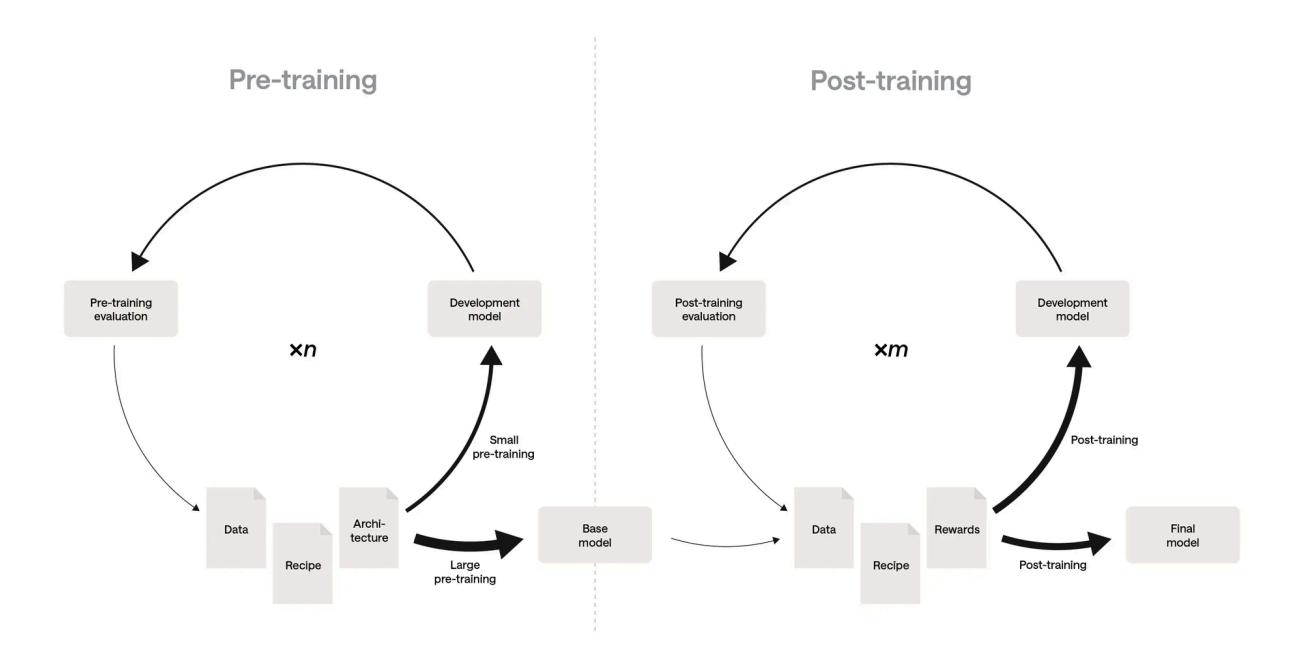
Three costs of running that manually, and the third is the one the post is actually about.
Every manual step is a chance to get it wrong. Their illustration: a data mix handed over
as a database path in Slack, a multi-week run that dies two weeks in on a full storage quota,
nobody willing to delete the 30TB dataset with do_not_delete in its name, GPUs idle while
this is resolved, and a relaunch reconstructed from memory and Slack threads.
The team forgets what it learned. No durable record of why a hyperparameter has its current value, no formal link from a data mix to its constituent datasets, no attribution from a model back to the recipe that produced it. Their example is an SFT team re-running a sweep it had already run months earlier against a different checkpoint, without realising.
Infrequent manual handoffs fragment ownership. SFT hands a checkpoint to RL, the final model underperforms, and two weeks go into deciding whose stage is at fault. Neither team can run the other's, so each optimises its own slice rather than the model at the end.
The root cause they give is one sentence, and it is the same claim the OpenAI post makes about application code:
the pipeline lives in the minds of the team rather than in a shared, durable artefact
What lifting it into code buys
Savanna implements the pipeline and the processes around it as ordinary imperative code —
post_train is a function that awaits sft, spawns an evaluation, awaits rl, spawns
another, and returns both. Three named gains:
- Composability. Manual steps become functions with typed inputs and outputs, so they
compose into an end-to-end run that launches with one click, repetitive work becomes a
forloop, and testing means running a subset or a downscaled parametrisation of the real thing. - Consensus.
mainis the team's current best understanding of how to train a model. The recipe is in the code, so there is no setup to reconstruct and no flag to forget. - Provenance. Comments and commit history carry the reasoning; a past run is reproducible because the commit that produced it can be checked out and rerun.
The organisational consequence is the part I'd not have predicted. Labs scaling up normally decompose training temporally — one team per stage. If any team can launch the whole pipeline, you can decompose by capability instead: a team owns a model behaviour end to end. Theirs owns multilinguality, and builds the SFT datasets, RL environments and evaluation suites that German language and culture require.
They are explicit that this only works with trunk-based development — small changes landing on
main as early as possible. Long-lived branches pay the same integration debt as the manual
handoffs did.
How it runs
Savanna lives in GitHub and CI is the entry point for training. Push a branch, or launch
from the GitHub UI; training their best model is triggering CI on main. Two gates sit around
that:
- Every PR runs a small-scale end-to-end training run in under five minutes, so contributing never feels slow.
- Every night, a larger end-to-end run asserts that the resulting model achieves a measurable improvement on the evaluation suite — a semantic regression test for the training logic itself.
Runs are hermetic. Non-code artefacts — data, models, tokenisers — are immutable and versioned in a registry, and a run links its referenced artefacts, logs, metrics and evaluation results to the resulting checkpoint. Their line for what that replaces: to find which models were trained on a given dataset you query the lineage graph, not Slack search.
Because the pipeline is a function, a sweep is a nested loop over parametrisations. The
workflow engine deduplicates the redundant work — four post_train calls varying SFT and RL
learning rates only run SFT twice, since two of them share their inputs and can read the
other's output from cache once it lands:
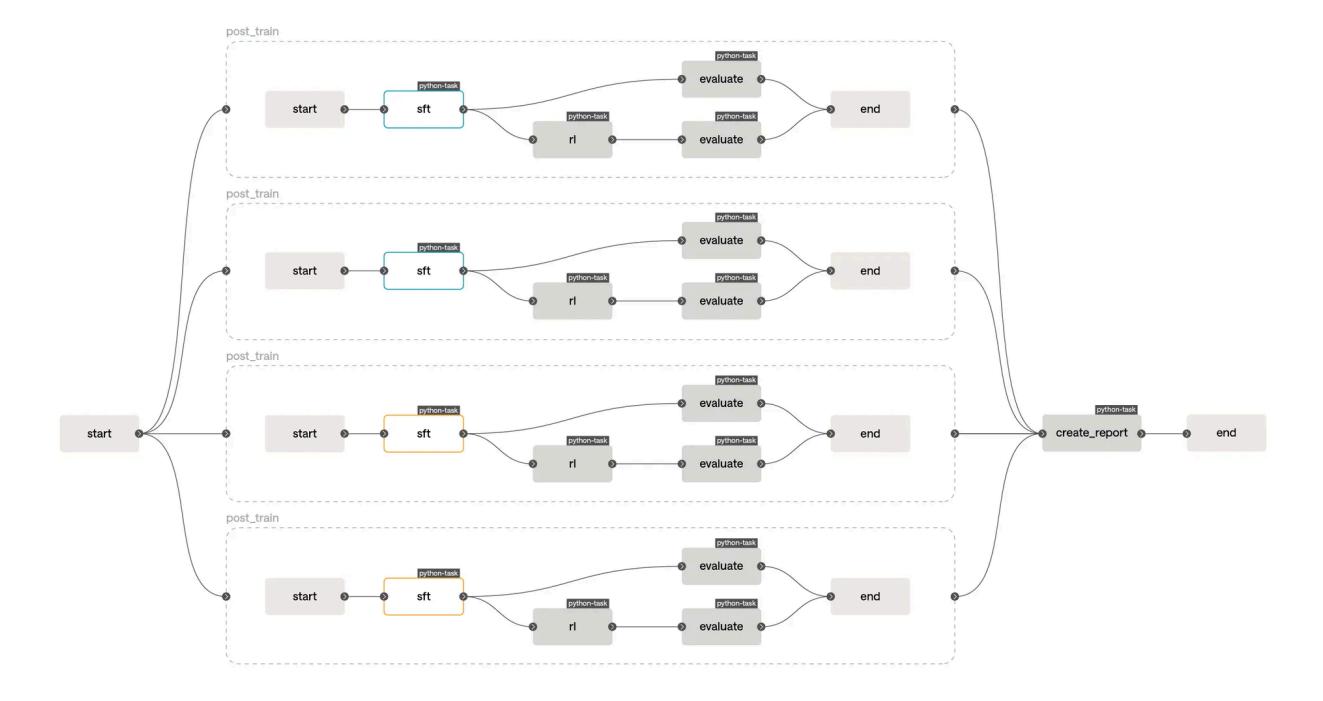
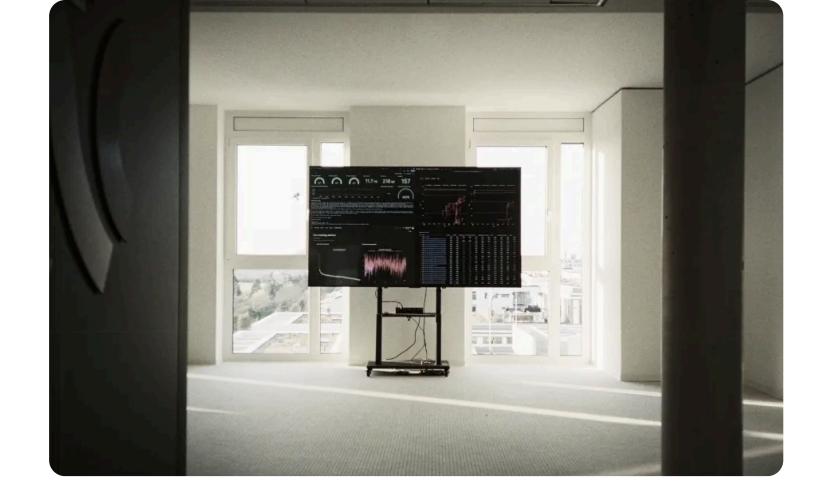
Underneath: Flyte on Kubernetes for durable execution, sequencing, parallelism, retries, caching and the UI above; artefacts in an on-prem object store with versions tracked in Weights & Biases; data streamed to the GPU clusters; metrics to monitoring with alerts. Long runs emit and evaluate intermediate checkpoints as they go, and a finished run is automatically benchmarked, written up as a report, and posted to a leaderboard on a screen in the Heidelberg office.
What it changed, by their account
Day to day: most of their work is small-scale experiments and sweeps, and the launching and evaluating is now automatic, so the effort moves to analysing results and designing the next experiment.
The claim I find most concrete is about the single large run. During their most recent pre-training run they stopped and resumed several times to tune the setup as the automated intermediate evals taught them how the model was behaving. Each relaunch was quick and low-risk because there was no setup to reconstruct — and therefore it did not have to be the same person twice. Whoever was on hand could pick it up. That is the clearest statement I have read of what "consensus in version control" is actually worth: it converts a person into a role.
Where I'd push back
There is not a single before/after number. "We iterate faster", "our learning rate as an organisation has significantly increased" — no measurement of either, no cost for the factory itself, and no figure for what the nightly full-pipeline test burns in GPU hours. The one number in the post is the five-minute PR check. Every other source in this cluster gets the same complaint, and this one has the least excuse: they built the artefact-lineage system that would let them answer it.
The before-picture is the author's own composite. The Slack handoff, the do_not_delete
dataset and the re-run sweep are told as a narrative of how a manual lab works, unattributed
and undated. Probably drawn from life — it is too specific not to be — but it means the
argument for MTaC rests on a story rather than on a comparison, and there is no version of the
counterfactual where the same team kept working the old way.
A downscaled run passing is not the full-scale run passing. They don't claim otherwise, and the nightly semantic-regression test is the right idea. But the failures that cost thousands of GPU hours are mostly the ones that only appear at scale, and the post doesn't say whether the gates ever caught one.
The gate is a metric, and the metric is theirs. "Asserts a measurable improvement on our evaluation suite" is a merge condition tied to a score the same organisation maintains. Karpathy's warning applies directly — a loop run against a metric for long enough will overfit it — and the more of the pipeline you automate against that assertion, the more of your model's direction it silently sets. Nothing here checks the check; see Generator–evaluator loops.
And the scale it was built at is not the scale most readers work at. The talk note (2026-08) names this as a category transfer, and it is the right complaint to attach to this page. Savanna is a frontier-pretraining factory run by a team that can afford a nightly end-to-end training run as a regression test; a consultancy post-training a 4B model for one client has neither that budget nor that cadence. Worth separating the two halves, because the argument is almost all in the cheap half. Transfers cheaply: hermetic runs, config-as-code, immutable artefact versioning, lineage from checkpoint back to recipe, CI as the entry point. Does not: the bespoke registry service, one-click multi-stage orchestration, and the nightly full-pipeline run. The post never claims to be a blueprint for anyone else — but it also never draws that line, and read as one it prices the whole factory.
None of that undoes the main thing, which is that this is a lab describing infrastructure it runs in production rather than an experiment it ran once.
Where it connects
It is the same claim as the OpenAI post, from a different industry. "What the agent can't access in-context doesn't exist" and "the pipeline lives in the minds of the team" are the same observation about durable artefacts, reached once from an agent's context budget and once from an org chart — see Harness engineering: an agent-first repository (OpenAI, 2026-02). Both answer it with version-controlled text, mechanical CI gates and trunk-based development. The convergence is worth something precisely because Aleph Alpha is not writing about agents at all until the last paragraph.
It supplies the substrate Auto Research assumes. Karpathy's version of the autonomous
research loop needs a pipeline an agent can read, modify and run, and his program.md is a
gesture at specifying one. Aleph Alpha closes the post by naming exactly that as the payoff —
with the pipeline in code, an LLM agent can read, modify and run it autonomously, they are
beginning to explore this, and the ambition they state is a model that self-improves via
Savanna. So the honest reading is that they built the prerequisite and are at the start of the
thing itself, which is one more datapoint for the shape Auto Research: taking the researcher out of the loop describes: the loop
is not the hard part, the surroundings are.
And the substrate has a curriculum to go with it now. The post says a pipeline in code is readable and runnable by an agent; it does not say what you would train the agent on. Greenblatt's account (2026-08) is the missing half: environments at three scales — small full pretrains, small post-training runs on a near-frontier model, a few genuinely frontier-scale experiments — plus capability targets with the mechanism left open, and bug-finding as a gradable task. Two of those depend on properties this post is about. Hermetic one-click runs are what make an environment reproducible enough to score, and artefact lineage from checkpoint back to recipe is what makes a fair comparison between two attempts possible at all. So the two sources fit together better than either claims: this one is the machine, that one is what you would drive through it. Worth noting that the one part of the job Greenblatt expects to stay unverifiable — calling a large experiment you only get a few tries at — is also the one the factory does nothing about. It makes each try cheaper to launch and no more predictable.
It puts a second answer under the "where does this run" question. Keeping an agent running: goals, loops, hooks and schedules collects the mechanisms that start the next turn on a developer's machine; this is the industrial version — CI as the trigger, a workflow engine with durable execution and retries, a cluster that stays up. Nothing about it is agent-specific, which is the point: the hosting problem for long autonomous runs was solved for batch compute a decade ago.
Capability teams are speciation at the org level. Karpathy expects specialised models and doesn't see them, and gives a lab-side reason: a lab serving everybody can't know what will be asked next. A capability-oriented post-training team owning German language and culture is a partial counter-example — the specialisation is real and it is organisational before it is architectural, which is a route to it his framing doesn't consider.
And the tooling gap it half-fills. His other claim was that we have no primitives for working with models other than the context window, and that touching weights is still a developing science. Savanna is a factory for touching weights, so the primitives exist somewhere. What the post doesn't claim is the part he was talking about — nothing here makes a fine-tune predictable or capability loss avoidable; it makes the process repeatable and attributable. Better bookkeeping around an unsolved problem is real progress and is not the same as solving it. See Reading notes: LLM Customization and Fine-Tuning (Bahree & Tok) for the continuum this would sit on.
The loose end I'd rather flag than stretch
This repository is the same move for a notebook — the operations are markdown files in
.claude/commands/, sources are immutable, every run is logged, and provenance is its
central rule — and the three gains MTaC claims map onto it almost term for term. That
correspondence is real but cheap: there are no GPUs here, no metric, and nothing that costs
thousands of dollars when it goes wrong, which is what made any of this worth building for
them. Worth noticing once; not worth building a page on. See The LLM-wiki pattern: the idea this notebook runs on.
Linked from
- Agentic engineering: the work moves to the harnessThe emerging discipline around long-running coding agents — designing the scaffolding, feedback loops and environments that let an agent do reliable work, rather than writing the code yourself. Entry point for the harness-design cluster in this notebook.
- Auto Research: taking the researcher out of the loopKarpathy's name for an agent loop that improves a model without a human in it — an objective, a metric, boundaries, and go. What it did to a repo he had hand-tuned for two decades, the one constraint that decides where it applies, and the parallel version he has not solved.
- Containerising AI researchWhat it would concretely take to train a model to do AI research — the environments, the three scales they run at, and the one part of the job Greenblatt thinks stays unverifiable. Plus the argument that algorithms rather than bought human judgment have been driving progress, which is what makes the whole thing work.
- Harness engineering: an agent-first repository (OpenAI, 2026-02)Notes on Ryan Lopopolo's OpenAI post — five months shipping a product with no hand-written code, and what a repository has to look like for that to work: docs as the system of record, a bootable app per worktree, custom linters as taste enforcement, and continuous cleanup of agent drift.
- Linting as an agent guardrailCustom lint rules as the enforcement layer for conventions an agent would otherwise drift away from — architecture boundaries, taste invariants, documentation freshness. Why a linter beats an instruction, and what to put in the error message.
- Loop engineering: from writing prompts to writing loopsThe claim that the unit of work is shifting from the prompt to the loop — Cherny, Osmani and Guzman all saying a version of it — and why the interesting question is not how to keep an agent running but who decides what "done" means.
- Note on the Prague training-harness talk — "2027 will be the year of specialized language models"Planning note for a 50-minute talk in Prague — the business case for specialized small models, then the training harness live. Includes the evidence check that killed the original opening slogan, the six conditions under which fine-tuning is the right call, and the caveat about borrowing a frontier lab's factory as a template.
- Speciation, and why we only ever touch the context windowKarpathy expects specialised models and does not see them arriving, and his explanation is that adjusting weights without losing capability is still an underdeveloped science while context windows just work. Plus where he puts the open-weight models — six to eight months behind, and better off there.